Table of Contents
Introduction
Graduating from college and stepping into the professional corporate environment is one of the most exciting yet challenging milestones in a student’s life. From campus placement drives and walk-in hiring events to virtual corporate screening rounds, fresh graduates are expected to present themselves with clarity, poise, and professional competence.
While academic performance and a strong GPA get your resume noticed by HR recruiters, your performance during placement evaluations determines whether you secure the job offer. Knowing technical concepts and articulating them fluently in real time are two very different capabilities.
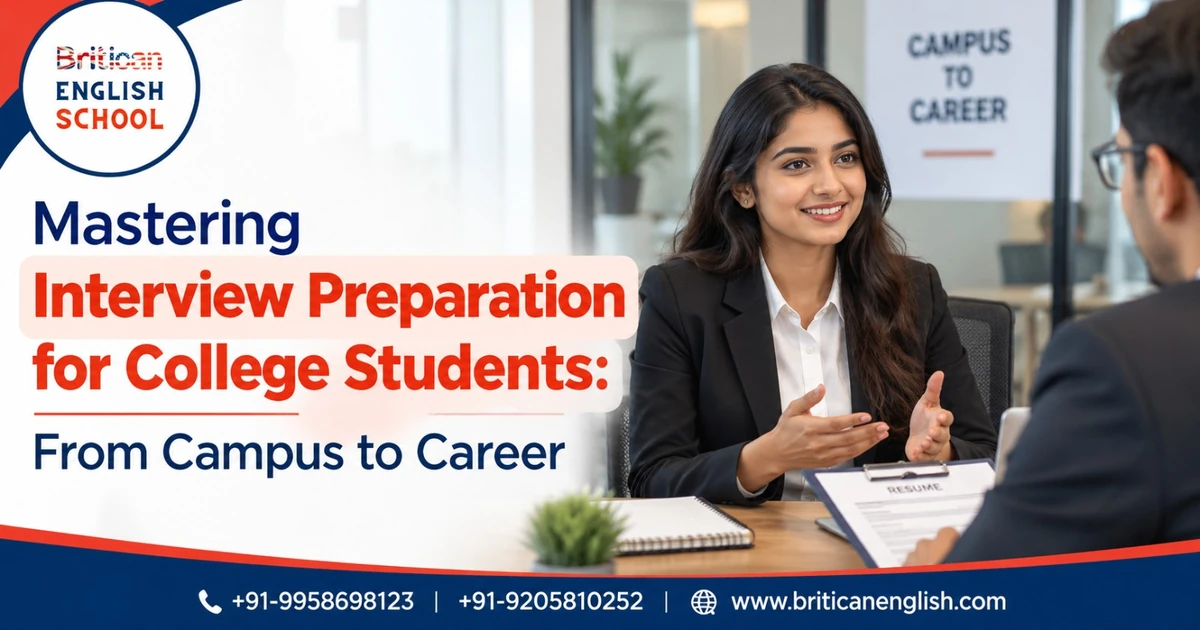
This is where structured Interview Preparation for College Students plays a decisive role. With guided training, regular conversation practice, mock interview drills, and targeted feedback, college students can bridge the gap between academic learning and corporate expectations to step into interviews with genuine confidence.
The Transition: Why Interview Preparation for College Students Matters ?
English serves as the primary language of global business, corporate networking, and technical evaluations. During campus recruitment drives, students are evaluated not only on domain knowledge but also on their verbal delivery, reasoning, and conversational confidence. This is why joining Spoken English Classes for College Students has become an important step in placement preparation.
Although universities cover theoretical curricula, traditional academic environments often lack sufficient time for individual public speaking or corporate interview simulations. A student may excel at written exams and understand complex engineering or management theories, yet hesitate when asked to deliver a 90-second professional self-introduction or handle a behavioral situation.
Enrolling in a dedicated English speaking course for college students in Noida helps young candidates bridge this exact gap. A well-structured English Communication Course for College Students provides regular, hands-on practice that transforms passive theoretical knowledge into active, spontaneous corporate communication. With mock interviews, group discussions, and personalized feedback, students develop the clarity, structure, and confidence needed to perform well in HR rounds, technical interviews, and campus placements.
What Is Comprehensive Interview Preparation?
Modern interview preparation for college students extends beyond simply memorizing answers to common HR questions. It is a holistic skill-building process designed to develop both technical presentation and interpersonal communication.
A well-rounded training framework typically includes:
- Professional Self-Introductions: Crafting concise elevator pitches covering present academics, past accomplishments, and future career objectives.
- Behavioral Answer Structuring: Utilizing frameworks like the STAR method (Situation, Task, Action, Result) to present past projects effectively.
- Fluency & Pronunciation Refinement: Eliminating native language influence, excessive pauses, and informal filler words.
- Corporate Vocabulary Development: Learning industry-relevant vocabulary and professional phrasings.
- Group Discussion (GD) Tactics: Practicing opening techniques, active listening, polite intervention, and summarization.
- Body Language & Etiquette Coaching: Mastering non-verbal cues including eye contact, professional posture, firm handshakes, and virtual call etiquette.
- Mock Interviews: Undergoing simulated panel interviews with real-time feedback.
Why College Students Benefit from Guided Training?
Students develop true professional fluency when given consistent opportunities to apply their communication skills. Practice transforms abstract grammar rules into second-nature expression, and a structured English Speaking Course for College Students in Noida provides exactly this kind of regular, guided practice.
For example, a student might study business vocabulary terms like collaborate, mitigate, or deliverable. Simply memorizing definitions provides passive recognition; utilizing these terms naturally during a mock interview turns them into active vocabulary. Strong English Communication Skills for Students are built through this kind of repeated, real-world application rather than memorization alone.
Furthermore, participating in specialized spoken English classes for college students builds psychological confidence. Recognizing that you can respond to unexpected questions without stumbling lowers anxiety and prepares you for real placement stress.
Key Benefits of Structured Interview Preparation
1. Increased Confidence Under Pressure
Nervousness often stems from fear of mispronunciation or structural errors. Guided corporate training creates a supportive, constructive space where mistakes become learning opportunities, allowing students to speak freely and confidently.
2. Expanded Professional Vocabulary
Corporate communication requires tailored vocabulary. Enrolling in specialized English communication course for college students programs exposes candidates to professional jargon across domains like IT, marketing, finance, and consulting.
3. Crisp Pronunciation and Articulation
Clear speech ensures your technical expertise is communicated effortlessly. Guided repetition, voice modulation exercises, and phonetics practice refine pronunciation and tone.
4. Active Listening Skills
Answering questions accurately depends on understanding the interviewer’s core intent. Dedicated listening drills train students to grasp multi-part questions quickly and formulate organized responses.
5. Stronger Sentence Formation and Spontaneity
Understanding grammar rules on paper does not automatically guarantee spontaneous fluency. Repeated mock scenarios train the brain to structure professional sentences in real time without silent gaps
6. Superior Performance in Campus Placement Rounds
Candidates with strong English communication skills for students excel during group discussions, technical presentations, and final HR rounds, setting themselves apart from peer applicants.
Core Pillars of Interview Success
A balanced training curriculum for Interview Preparation for College Students focuses on six critical communication pillars. The first is the self-pitch, or 90-second elevator pitch, where students craft a concise, engaging personal introduction that highlights their current academic standing, past projects, and future career goals. The second is behavioral answer structuring using the STAR method, which teaches students to frame real-world experiences through Situation, Task, Action, and Result so that every answer is logical and outcome-focused.
The third pillar is business and contextual vocabulary. Good English Speaking Classes for College Students teach industry-specific terminology and corporate phrasing through real business case studies rather than isolated word lists. The fourth pillar, active listening and responsive thinking, trains students to quickly grasp multi-part interviewer prompts, analyze the core intent, and formulate structured answers without long silent gaps.
The fifth pillar covers group discussion dynamics, where students learn to participate strategically through polite intervention techniques, active listening, idea building, and logical summarization. The sixth pillar is non-verbal cues and executive etiquette, which includes developing professional body language such as steady eye contact, upright posture, and natural hand gestures, along with polite virtual call etiquette. Together, these six pillars make Interview Preparation for College Students complete, and the right English Speaking Classes for College Students ensure each skill is practiced until it becomes natural.
Activity-Based Learning & Mock Interview Simulations
Students respond best to interactive, practical activities, which is why a good English Speaking Course for College Students in Noida replaces passive lectures with dynamic exercises. Quality English Speaking Classes for College Students make learning active, so every session builds real speaking ability instead of theoretical knowledge.
Role-play scenarios are one of the most effective methods. Students simulate realistic corporate interactions such as handling a difficult customer, pitching a software solution, or negotiating project deadlines. Another popular exercise is the “30-Second Elevator Pitch,” where students practice summarizing complex technical projects concisely within strict time limits. Well-designed Spoken English Classes for College Students use this kind of timed practice to build clarity and confidence.
Case study brainstorming adds a collaborative element. Students analyze corporate problems in small teams and present their solutions to an evaluation panel, which strengthens reasoning and presentation skills. Finally, video recording and review lets students watch their own mock interviews and analyze body language, filler word frequency, posture, and facial expressions together with their trainers. A complete English Communication Course for College Students includes this reflective step, because seeing yourself speak is one of the fastest ways to improve.
Whether you choose English Speaking Classes for Students in Noida for placement preparation or to build general confidence, these practical activities help develop strong English Communication Skills for Students that last well beyond the classroom.
Selecting the Right Training Center in Noida
Choosing the right institute can accelerate your career readiness. When evaluating programs, consider the following parameters:
1. Qualified Corporate Trainers
Choose institutes with mentors who possess proven corporate recruitment or industry experience to ensure real-world relevance.
2. Practical Speaking Ratio
Prioritize programs that dedicate the majority of class time to interactive mock interviews, role-plays, and group discussions over passive lectures.
3. Small Batch Sizes
Opt for centers that limit class size so trainers can provide personalized attention and detailed, one-on-one feedback
4. Comprehensive Curriculum
Ensure the syllabus covers all placement stages, including resume building, STAR method workshops, GD rounds, and corporate etiquette.
5. Assessment & Feedback Regularity
Select centers that conduct routine mock interview panels and provide structured performance evaluations to track your growth.
Selecting trusted English speaking classes for students in Noida near major learning hubs gives college candidates a localized advantage during competitive campus placement cycles.
Creating a Career-Ready Environment at Home and Campus
Outside the classroom, creating a daily English-friendly environment helps consolidate what you learn in English Speaking Classes for Students in Noida. Whether you are enrolled in an English Speaking Course for College Students in Noida or attending English Speaking Classes for College Students closer to campus, consistent practice at home builds the English Communication Skills for Students that employers look for during campus placements.
One of the best habits is forming a peer study group. Conduct weekly mock interview sessions with classmates, where you challenge each other with unexpected technical and HR questions. Another useful habit is industry reading. Read business publications, industry news blogs, and tech articles out loud to build unfamiliar vocabulary and a natural sentence cadence. These habits work well alongside Spoken English Classes for College Students, which give you expert feedback on your progress.
Vocabulary journaling also makes a big difference. Maintain a professional vocabulary log, write down new industry terms every day, and actively use them in your responses so they become part of your everyday speech. Finally, practice self-recording. Use your phone camera to record yourself answering common HR questions, then evaluate your tone and posture during playback. Combined with a structured English Communication Course for College Students, these daily habits turn classroom learning into lasting, confident communication.
Overcoming Hesitation and Building Verbal Confidence
Many students understand English perfectly well but freeze when asked to speak during high-stakes job evaluations.
To overcome speech hesitation:
- Start Small: Begin with short 30-second responses before attempting long, complex explanations.
- Embrace Mistakes as Growth: View initial grammatical slip-ups or pauses as essential stepping stones toward fluency.
- Practice Silent Pauses: Replace filler sounds like “um,” “uh,” or “like” with brief, confident silent pauses to collect your thoughts.
- Focus on Communication Over Perfection: Prioritize clarity of thought over flawless grammar—interviewers value clear, logical problem-solving above all else.
Developing Communication Beyond Basic Technical Fluency
As your preparation progresses, your focus shifts through three stages of development, moving toward higher-level executive communication skills. English Speaking Classes for Students in Noida can guide you through each stage with structured practice and expert feedback.
Level 1: Basic Technical Fluency
Build core spoken clarity, correct grammar, accurate pronunciation, and a foundational vocabulary so you can explain domain concepts with confidence.
Level 2: Structured Responses
Learn to organize your thoughts under pressure. You’ll practice frameworks like the STAR method for behavioral questions and craft a concise 90-second elevator pitch.
Level 3: Executive Presence & Leadership
Master advanced skills such as persuasive negotiation, critical debate, non-verbal confidence, and strategic leadership during group discussions.
Developing these skills prepares you not just to clear the entry-level HR interview, but to excel in future corporate leadership roles. If you are looking for English Speaking Classes for Students in Noida, choose a program that takes you through all three levels, from fluency basics to leadership communication.
Tracking Progress and Maintaining Consistency
Consistent effort yields measurable progress. When evaluating your interview readiness, monitor practical milestones:
- Reduced frequency of filler words during spontaneous answers.
- Increased ease when answering unexpected situational questions.
- Improved posture, natural eye contact, and relaxed hand gestures.
- Logical structure in answers without rambling.
Allocating just 20 to 30 minutes daily to focused mock practice, reading out loud, or vocabulary drills will build lasting fluency faster than infrequent cramming sessions.
Also read – Transform Your Child’s Communication: Best Spoken English Classes for Kids in Noida
Conclusion
Comprehensive interview preparation for college students turns academic knowledge into long-term professional success. By combining thorough company research, behavioral frameworks, vocabulary expansion, mock interview drills, and etiquette training, college candidates can approach recruitment drives with authentic confidence.
Enrolling in specialized spoken English classes for college students gives fresh graduates a structured, supportive environment to refine their communication and land their ideal entry-level corporate roles.
Every interview is a valuable learning opportunity. With consistent practice, professional guidance, and a commitment to personal growth, you can successfully navigate the transition from campus to career.
Q1. Why should students consider specialized interview preparation courses?
Specialized courses offer structured mock interview practice, industry-specific vocabulary building, body language coaching, and real-time feedback that standard academic classes rarely provide.
Q2. How do spoken English classes differ from regular college English subjects?
Academic college English focuses on literature, written grammar, and reading comprehension. Spoken English and corporate communication classes focus on verbal fluency, spontaneous conversation, public speaking, group discussions, and interview performance.
Q3. Can structured preparation help students who understand English but struggle to speak fluently?
Yes. Regular conversational drills and mock interview practice bridge the gap between passive understanding and active spoken fluency, helping students eliminate hesitation and build confidence.
Q4. What specific activities are used during interview preparation classes?
Common exercises include peer role-playing, mock interview panels, group discussions, video-recorded speech reviews, STAR method answer structuring, and short presentation drills.
Q5. Is online interview preparation as effective as offline classroom training?
Both formats are effective. Online classes offer flexibility, convenience, and direct practice for virtual job interviews. Offline classes provide direct face-to-face interaction, physical group discussions, and real-world environment exposure.
Q6. When should college students begin preparing for campus placement interviews?
Students should ideally begin structured preparation 3 to 6 months before campus recruitment drives begin, giving themselves ample time to build vocabulary, refine body language, and master mock interview rounds.